How to Choose the Right Gasket Material for Industrial Sealing
By MKS Pipe & Valve Technical Team | June 2, 2026
A practical guide to selecting gasket materials for industrial flanges, covering temperature, pressure, chemical compatibility, and the common material families.
A gasket is one of the smallest parts in a piping system and one of the most consequential. It sits between two flanges and is the only thing standing between contained media and a leak. Get the material right and the joint seals for years. Get it wrong and you are chasing leaks, replacing bolts, and risking the media you are trying to hold. This guide covers how to choose gasket material with the same care you would give a valve or a length of pipe.
What a Gasket Does and Why Material Matters
A gasket fills the microscopic gaps between two flange faces. As the bolts are tightened, the gasket compresses and conforms to the surfaces, creating a seal that holds against the system pressure. To do that job, the material has to survive the temperature, resist the media chemically, and recover enough under load to keep sealing through pressure and thermal cycles.
That is why material choice is not a default. A gasket that seals cold water perfectly may fail in minutes on a steam line. One that handles steam may swell and break down in the wrong chemical. The material has to be chosen for the specific service, not pulled from whatever is on the shelf.
The Key Selection Factors
Five factors drive nearly every gasket decision. Work through all of them, since any one can disqualify a material.
- Operating temperature. Both the normal range and any excursions. Elastomers have firm temperature ceilings. Graphite and metal materials handle far more.
- System pressure. Higher pressure needs a material and design that resist blowout and hold under load.
- Media and chemical compatibility. The fluid or gas has to be compatible with the gasket. This often narrows the field fast.
- Flange type and surface finish. Raised face, flat face, and ring type joint flanges each call for different gasket styles, and the surface finish affects how well a given material seats.
- Flange pressure class. The class sets the load the gasket will see and helps point you to an appropriate style.
Common Gasket Materials and Where They Fit
With those factors in mind, here is how the common material families line up.
Soft sheet materials
Compressed non-asbestos fiber sheet is a versatile, economical choice for water, air, and many moderate services. It cuts easily and seals well at lower to mid temperatures and pressures. PTFE resists an exceptionally wide range of chemicals, which makes it a strong pick for aggressive media, though its temperature and creep behavior set practical limits.
Flexible graphite
Flexible graphite handles high temperatures and is well suited to steam and hot process service. It resists a broad chemical range and recovers well under thermal cycling, which is why it shows up so often in steam systems.
Spiral wound and metal gaskets
Spiral wound gaskets pair a metal winding with a soft filler to seal under higher pressure and temperature than a flat sheet can manage. They are a workhorse for raised face flanges in steam and process piping. For the most severe service, solid metal and ring type joint gaskets seal extreme pressures and temperatures where nothing softer will hold.
Elastomers
Rubber based gaskets fit lower temperature, lower pressure services, with the specific compound chosen for the media. EPDM suits water and many water based services. Nitrile suits oils and fuels. Viton handles a broad chemical range and higher temperatures than most elastomers. Each has a clear lane, so match the compound to the fluid.
A Short Framework for Matching Gasket to Service
When you sit down to choose, run this quick sequence. Start with temperature, since it eliminates whole material families at a glance. Layer in chemical compatibility with the media, which narrows the field further. Confirm the pressure and flange class so the style and load capacity fit. Finally, check the flange face type and finish so the gasket seats properly. What survives all four is your candidate. And remember, every time you break a flange joint, install a fresh gasket. A used one has taken a set and will not seal the same way twice.
Where MKS Comes In
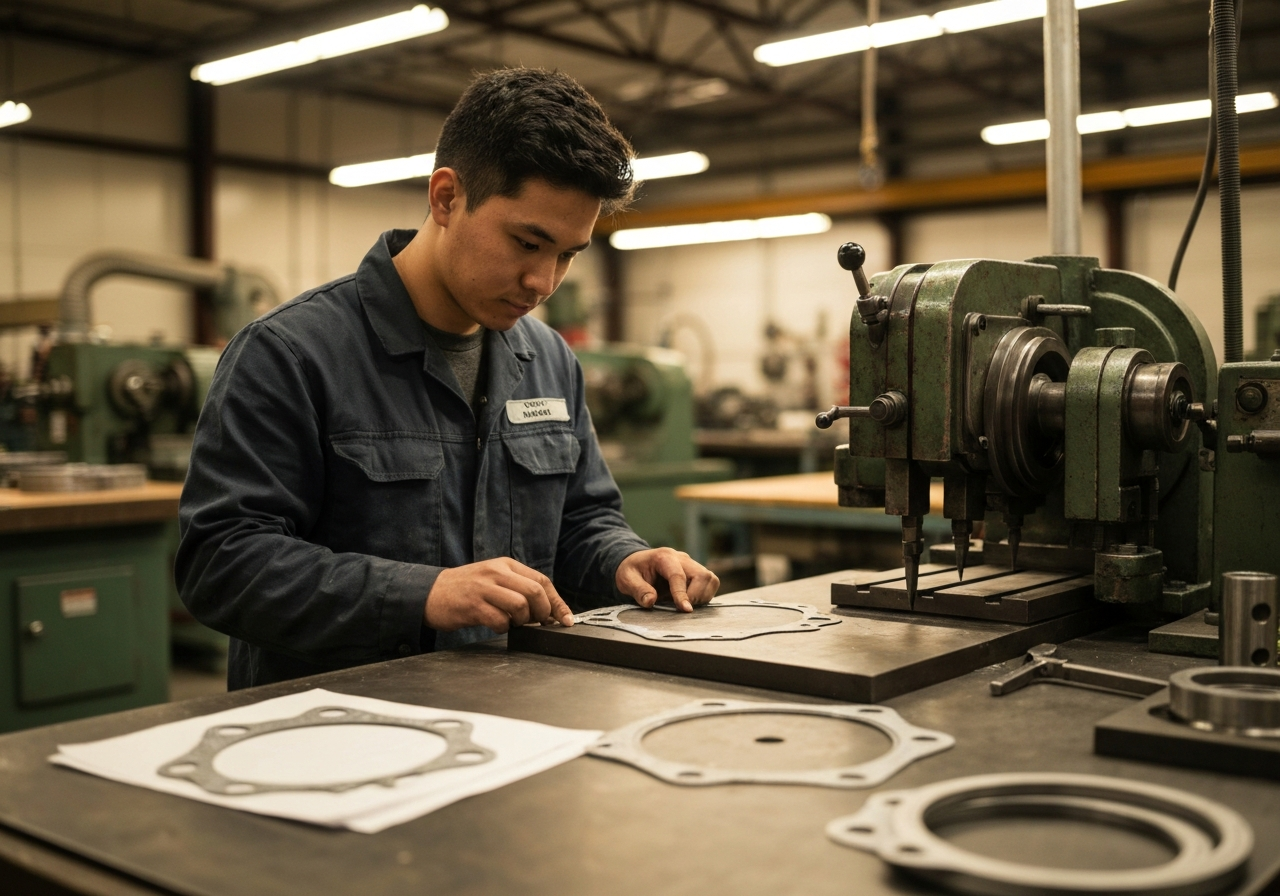
MKS Pipe & Valve has supplied PVF to the Midwest since 1946, and gaskets are a place where our in-house machine shop earns its keep. We cut custom gaskets to your flange spec and material in house, so you are not waiting on an outside shop’s lead time when a line is down. With more than 8,500 items stocked across Kansas City, KS and Omaha, NE and most orders shipping in under 24 hours, the parts that surround the gasket are on the shelf too.
Tell us your media, temperature, pressure, and flange details and we will get the material right before it ships. Contact our team at (888) 665-2696 or info@mkspvf.com, or browse stock anytime at shop.mkspvf.com.